Showing posts with label Miyu. Show all posts

Monday, July 16, 2012

Barong Tagalog, The Philippine National Costume by Miyu

Barong Tagalog is the formal men's wear of the Philippines. Last time, I focus on the Chinese long dress for women so this time I chose men’s costume. One of my Philippine friends told me that the Barong Tagalog has always been considered a staple. Almost every Filipino male has one in his closet, or at least has worn it once in his lifetime.


History:
The history of Barong Tagalog goes back to Spanish-colonial era (1565-1898). The Spanish rulers demanded the Filipino men to wear the Barong Tagalog because they wanted to make the differences between themselves and the 'natives' visible by the dress. Barong Tagalog’ s material should be transparent so that Philippines cannot hide any weapons against the Spanish rulers. Also pockets were prohibited. However, the Barong Tagalog gained its power, prestige, and status when President Quezon, the first Filipino president, declared it the National dress. The status of the lowly inferior Barong thus became another symbol of Filipinos' resistance to colonization. During his brief term, he made it fashionable as business and formal wear. Today, Barong Tagalog is worn in special occasions. The Filipinos (as well as non-Filipinos) continue to wear the Barong Tagalog with distinguishing acceptance world-wide.

Trivia:
Today, every visitor and foreign dignitary invited to a Palace must be dressed to a Barong Tagalog. The invitations specifically say come in "Barong" instead of the traditional "Coat and Tie". Thus, every one invited to dinner at the Presidential Palace and in many Filipino homes have to experience what it feels to have to wear his shirttails out, to suffer the indignity of having the material of his barong transparent so that he cannot conceal any weapon; and horrors, to be accused directly of incipient thievery by having no pockets in his barong to put the silver. So, when Spanish Ambassador is invited to a state dinner, you can say, "Ah, what sweet revenge!"
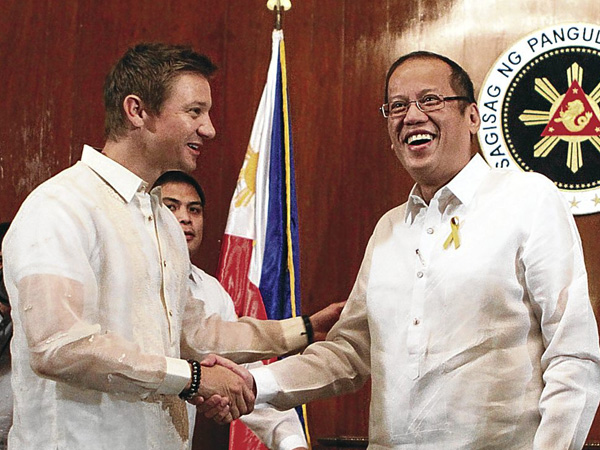
This is a photo of Hollywood actor Jeremy Renner and the President Benigno Aquino III in the palace.

Features:
Barong Tagalog’s material is transparent and we can see through it if you hold it against the light. Its color is traditionally creamy white and it is elaborated embroidery. This embroidery is an ancient craft that reached the Philippines even before the arrival of the Spaniards. (The needlework is one of Filipino traditions and Filipino girls in olden times, it is said, knew their worth by the way they pushed the needle!)


After I learned about Barong Tagalog’s history and features, I realized how strongly the world history and traditional costume are connected. The Barong Tagalog is beautiful but has a bitter past. It is important for us to know Philippine’s historical background to truly understand the Barong Tagalog’s real beauty and value.


Rethinking about Academic Writing by Miyu


Each professor in this university asks us to write essays in different style of academic
writing. As we can see from this, nobody can define what exactly academic writing is. The
answer to the question “what is academic writing?” is depend on each person and what he/
she writes. Each of us has to find our own way of academic writing. This is what I learned in
Professor Stan’s lesson.

Thursday, June 21, 2012

Very simple introduction for various traditional costumes by Miyu


Cheongsam: Elegant Chinese dress

https://blogger.googleusercontent.com/img/b/R29vZ2xl/AVvXsEhseGVJVd30ApGNlH9-4yxiK0SIyBv-wyPwu4jjSrIZL_Hrh2SROXRnACQSkuLi86_aBCgrlyfEqNPvsxUCc0OMCnrlN2XZOzJbRCKMURxNdx0VjGP3o06osRscMzvs7UtWHGIQ-N8yMuc/s1600/dragon-phoenix-cheongsam-sapphire.jpg


I chose ‘traditional costume in the world’ as my blog topic because simply I am interested in it and I though it is important to know about foreign country’s culture. As there are less and less opportunities to wear traditional costume, more and more people, especially young people, don’t know or care about their own countries’ traditional costumes. I think traditional costume is not only old, out of time and inconvenient but also full of the wisdom and idea of the old. When we learn more about traditional costume, we can know local people’s way of living, thinking, and customs. Knowing other countries’ traditional costumes may help us to understand their culture it-self because it represents the country’s background and history. I think trying to understand other culture and accept it is the important thing for us who living in this international society and learning international relations.

Cheongsam is an elegant one-piece Chinese dress for women. The name ‘Cheongsam’ simply means ‘long dress’ in Cantonese. The dress fits the body and has a high neck and the slits on the sides and often made of silk with frog-button closures and high collars.
It was started to be worn during the Ching Dynasty (1644-1911 AD), which was established by the Manchu people who were from Northern China. It is now worn for formal occasions such as weddings, engagements, and on the Chinese New Year.
The evolution of the cheongsam is interesting. The traditional Cheongsam was just a long loosely-fitted and baggy dress and the women were required to wear it. It does not reveal much, only the head, hands and the toes. But through the years, it becomes more fitting and modern to fit the standard cheongsam we know today. It can either be long or short, unlined or interlined, woolen or made of silk floss. We often see red Cheongsam with gold dragon or flower pattern on TV and images. People are always wearing red Cheongsam in the movies. I think it’s a kind of stereotype about the Cheongsam.

http://www.china-stylish.com/onlinestore/adminback/editer/UploadFile/20100518081245678.jpg
Nicole Kidman is wearing red Cheongsam with a sexy keyhole in her movie, “Australia” (2008).

Candy and Linda, my Chinese friends told me that the most popular Cheongsam is red one with gold pattern as we imagine. In china, each color has a meaning and red is the color of good luck, happiness, joy, and for brides, since it is of energy as symbolized by fire. They told me that cheap Cheongsam is available to buy at fifty thousand yen. A high-quality and luxury Cheongsam is extremely expensive so they don’t know how much it costs. Also unfortunately, they told me that although cheongsam is suitable for wearing in all seasons by old and young, very few people wear Cheongsam and they had worn it only a few times in their lives.
I hope you get interested in Cheongsam and keep in your mind about it. If you have any opportunity to wear Cheongsam, let’s wear it! I’m sure that you can feel Chinese people’s feelings and culture (a little) because Cheongsam features strong national flavor and embodies beauty of Chinese traditional costume.


Reference

Hongxia, Liu. (2009). Asian culture and history: The Cheongsam—the treasure of Chinese national apparel (vol. 1, no. 1, pp55- 57). Canada: Canadian Center of Science and Education.

Saturday, May 19, 2012

World Map by Miyu


When Professor Stan asked us to draw a world map, I thought “is it what we have to do in our English class?” After I saw all maps drawn by my classmates and exchanged our ideas, I noticed some interesting things. 

When I went to France, I was surprised because a world map was focused on France; and Japan drawn to the edge of the east. I had exactly the same feeling when I saw maps which were drawn by non-Japanese students. Something was wrong! Most of their maps were focused on their own country but it is quit a natural thing. We got used to thinking and seeing things in our own perspective. For me, Japan is always in the center of the world map. Everyone tends to think that our country is a standard and many people try to reject what they find strange because it is different from their standard or way of thinking. I think this is one of the causes of conflict, discrimination and war in this world. Trying to understand other culture, tradition and ideas is the important thing because now we have more opportunities to have inter-cultural communication than a decade ago. However, I think people in my class, both Japanese and non-Japanese, are enjoying these differences and find it interesting. I enjoyed seeing and comparing our world maps in the class, too because each of them were original and drawn differently. At the same time, I could notice that my view was one-sided and should be more flexible. 

We can find new things by seeing a map in different people’s perspective. For example, imagine if I were to be born and raised in a small village in Europe, I probably would not care about a tiny island country in the most eastern part of a map because it is too far away from my place and nothing to do with me as long as i'm not interested in robots or manga. Now, I understand why my French friends asked me the differences among Japan, Korea and China. For them, Japan is an uninformative country and never paid a lot of attention. Also I have to study more about the world because I couldn’t draw my world map correctly and know almost nothing about other countries. I have to pay more careful attention to the world affairs. As Ms. Hatcher (our professor of Introduction to the UN) always says, “People! We are majoring in International Relations!” I have to be aware of a student in this class and learn more things about the world. 

Recently I realized that I only know the surface of the things. Though I find this class interesting, I’m not quite sure that I really learned or gained something in this class. However, drawing a world map in the class gave me an opportunity to think about many things. I learned the importance of exchanging our ideas and share each other's viewpoint. I'm sure that studying in this class with students who came from all over the world will show me various point of views  and help me to have more flexifble way of thinking. It is necessary for us to understand and respect other people's idea; otherwise, we can't live in this world.


Miyu